Knowledge-sharing and networking to co-create FEAST interventions for healthy and sustainable diets
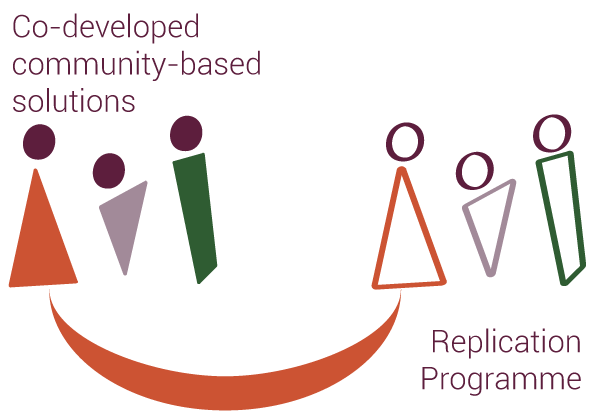
The FEAST Replication Programme is designed to support cities, research institutions and CSOs in the development and implementation of FEAST interventions for healthy and sustainable diets. The programme aims to facilitate the sharing, dialogue, translation and context-based adoption of good practices and lessons learned from FEAST with eight additional Replicators.
The objective of the Replication Programme is to establish regular exchange between FEAST Living Labs and Replicators to foster reflection and learning on how to design and implement interventions on healthy and sustainable diets.
By the end of the FEAST project, the Replicators will be able to draft an Action Plan to implement their own intervention.
Video in English with subtitles
What will FEAST Replicators do?
In the Replication Programme, Replicators participate in the following activities:
- Twinning: Each Replicator is twinned with a FEAST Living Lab, engaging in regular one-to-one and peer-to-peer exchanges.
- Knowledge sharing: Replicators draw on the collective experience of all Living Labs, who regularly provide updates on progress, opportunities and challenges, through e.g. webinars and Community of Practice meetings.
- Capacity Building: Replication Cities can join the Capacity Building sessions organised by FEAST and receive training from experts within the FEAST consortium and invited specialists.
- READ MORE HERE
Building on the knowledge and experiences gathered through these activities, Replicators write an Action Plan that explains how they will co-develop and implement a FEAST intervention with and for vulnerable groups, similar to those of the FEAST Living Labs.
The Living Labs interventions fall in four broad themes:- Food education: Engaging children, parents, school staff and older adults in tailored food education activities.
- Support for smallholder farmers: Facilitating market dialogues, mapping local producers, and providing targeted support for young farmers
- Food environments: Establishing farmers’ markets, urban gardens, social restaurants and outpatient clinics, and improving the spatial design of school canteens.
- Public food procurement: Updating suppliers and procurement criteria to promote healthier and more sustainable food systems.
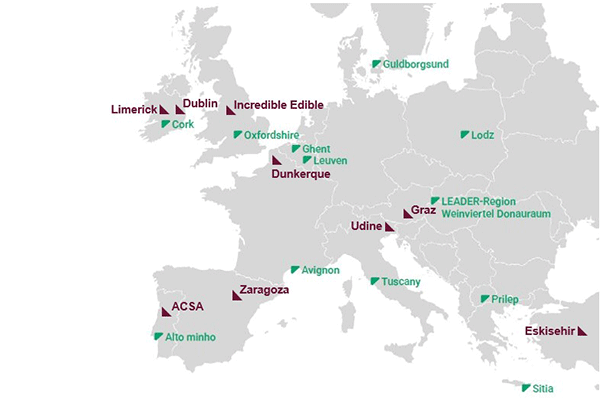
Replicators and their Living Lab twins
- ACSA – Alimentar Cidades Sustentáveis Associação (Portugal) → Prilep
- Eskişehir (Türkiye) → Leuven
- Udine (Italy) → Avignon
- Graz (Austria) → Ghent
- Incredible Edible (UK) → Cork & Lodz
- Dunkerque (France) → CIM Alto Minho
- Stepaside Educate Together (Ireland) → Tuscany
- Limerick Food Partnership (Ireland) → Oxfordshire
- Mensa Civica (Spain) → LEADER Weinviertel